 Owned
Owned

Russian Olive vs Pembina Plum
Prunus nigra x salicina Pembina
Elaeagnus angustifolia
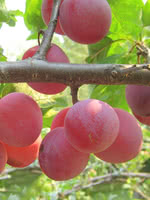
Pembina Plum is one of the best-tasting plums that can be planted on the prairies. It is semi-freestone with orange flesh that is soft, juicy, and sweet which contrasts with the thick, sour, dark red skin. The plums can grow up to 5 cm in diameter and are well-suited for fresh eating, baking, and preserves.
They typically ripen in mid to late August and should be picked as soon as they are ripe. If left too long, the fruit will fall off the tree.
Pembina Plum is a hybrid between Canada Plum and Japanese Plum. For fruit production, it needs to be planted with another variety for cross-pollination. Canada Plum and American Plum are considered universal pollinizers.
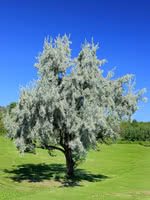
Russian Olive is a medium-sized deciduous tree that has attractive silvery coloured foliage with small yellow flowers that emit a fragrant sweet smell.
It is drought and salt tolerant, and works well as a shelterbelt species. Russian Olive can also be used to combat erosion.
Note: although Russian Olive is planted as an attractive boulevard tree in many northern areas, in warmer areas it can invade watersheds and is considered invasive. Please do some research and plant the right tree in the right place.
Pembina Plum Quick Facts
Russian Olive Quick Facts
In row spacing: 1.8 - 2.4 m (6 - 8 ft)