 Owned
Owned

Round-Leaved Sundew vs Knotted Rush
Drosera rotundifolia
Juncus nodosus
CUSTOM GROW
NOT AVAILABLE THIS SEASON - MIGHT RETURN
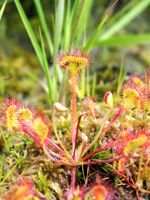
Round-Leaved Sundew is a native carnivorous plant, easily recognized by its bright green leaves covered in distinctive red, glandular hairs. These hairs secrete a sticky substance that is used to attract, trap, and digest insects. Their carnivorous nature allows them to survive in nutrient-poor, acidic soils where many other plants may struggle to grow.
They produce small white flowers that grow along the top of a slender, leafless stem. They can be found growing in wetlands, most often among sphagnum moss, in consistently moist, acidic soils. It does best in cooler summer climates and is intolerant of shade. Due to its small size, the plant can be difficult to spot in its natural habitat. Round-Leaved Sundew is an indicator of healthy wetland systems and is valued in ecological restoration and conservation projects.
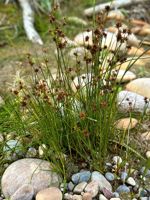
Knotted Rush is a native perennial wetland plant found growing in marshes, swamps, wet meadows, and along shorelines. It spreads by underground rhizomes to form colonies, which can also help stabilize soils and shorelines.
Its upright, slender stems and small clusters of greenish-brown seed heads add structure to wetland plant communities. Knotted Rush is well-suited to wetland conservation, rain gardens, naturalization, and restoration projects. As a cool-season grower, it grows actively during spring and fall, when temperatures are cooler.