 Owned
Owned

Mon-Fri 9am - 5pm Mountain time
Cart reopens in October
Subscribe to our email list
to stay updated
Black Elderberry vs Sweet Gale
Sambucus canadensis
Myrica gale
COMING SOON
(new stock expected: fall of 2026)
CUSTOM GROW
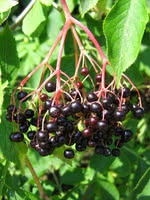
Black Elderberry is a deciduous shrub native to eastern North America. You can plant this shrub in moist areas and it will help stabilize your soil. You can also use it on rural properties anywhere you'd use a lilac.
Black Elderberries are considered to be partially self-pollinating. So while they will still produce some berries without cross-pollination, planting with another variety will increase yields. Consider planting with Ranch Elderberry or Bob Gordon Elderberry.
Warning: the seeds, stems, leaves, roots, and uncooked berries of the Black Elderberry are poisonous to humans when eaten in quantity. You should cook the berries to make them safe for human consumption.
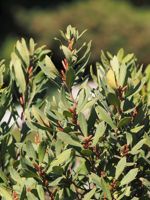
Sweet Gale is a native, nitrogen-fixing shrub known for its aromatic foliage. Tiny glands on the leaves release a balmy, bay leaf-like scent with floral and citrus notes. In spring, the yellowish male catkins provide one of the earliest sources of pollen for bees and other insects. While later in the season, the female catkins produce seeds that are eaten by waterfowl. Sweet Gale is dioecious, meaning male and female flowers occur on separate plants.
Sweet Gale thrives in wet, acidic soils and is commonly found along wetlands and lakeshores. It can help stabilize shorelines, while its dense growth provides valuable cover for wildlife. It is well-suited for naturalization, wetland restoration, and erosion control projects.
Black Elderberry Quick Facts
Sweet Gale Quick Facts
Toxicity: leaves, stems, and uncooked berries are poisonous to humans