 Owned
Owned

Mon-Fri 9am - 5pm Mountain time
Cart reopens in October
Subscribe to our email list
to stay updated
Black Locust vs American Plum
Robinia pseudoacacia
Prunus americana
NOT AVAILABLE THIS SEASON - MIGHT RETURN
NOT AVAILABLE THIS SEASON - MIGHT RETURN
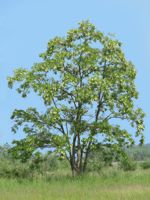
Black Locust is an attractive tree. Its distinctive leaves are made of about a dozen bright green leaflets. It also notable for its fragrant white flowers, which smell of citrus.
Black Locust can grow in many situations, but prefers dry areas with lots of sun. It is robust and is an excellent choice for establishing shade in dry, open areas.
Important note: Much of the Black Locust is toxic to humans and livestock, including seeds, bark, and leaves.
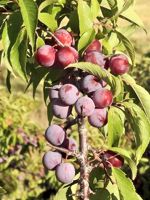
American Plum is a cold-hardy wild plum native to North America that grows as a small tree or large multi-stemmed shrub. Small, firm, red plums ripen from mid to late summer; the skin is tough and tart, whereas the flesh is sweet and juicy. While some enjoy eating them fresh, they are more commonly used for baking and preserves. It is considered a universal pollinizer for other plum varieties and is often used for grafting or as a rootstock.
In spring, American Plum produces abundant white to pink flowers that attract a variety of pollinators, providing an important early-season source of nectar and pollen. It also serves as a host plant for numerous moth and butterfly species. In its native range, it is recognized as an important keystone plant, as it has a disproportionately large impact on local ecosystems.
American Plum tolerates a wide range of soil conditions, from acidic to alkaline, and heavy clay. It is well suited to a variety of projects, including fruit orchards for cross-pollination, as well as pollinator plantings, naturalization, and restoration projects.
Black Locust Quick Facts
American Plum Quick Facts
Toxicity: leaves, stems, pits contain cyanide