 Owned
Owned

Sweet Gale vs Blue Honeysuckle
Lonicera caerulea
Myrica gale
CUSTOM GROW
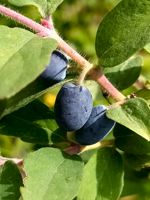
Blue Honeysuckle (wild Haskap or Honeyberry) is a cold hardy shrub and native to most of Canada. The pale yellow to white flowers provide nectar and pollen for bumblebees and other pollinators. The edible berries resemble elongated blueberries. They have a sweet-tart flavour often described as a blend of blueberry, raspberry, and blackcurrant, though wild berries can vary in taste.
Compared to popular cultivated varieties, the berries of Blue Honeysuckle are typically smaller and more variable in shape and flavour. While some enjoy eating the berries fresh, they are more commonly used in baking and preserves. Blue Honeysuckle can be used in hedgerows, border plantings, and naturalized landscapes. It may also serve as a cross-pollination partner in haskap plantings or as a decoy planting to draw birds and wildlife away from more desirable fruit crops.
Blue Honeysuckle has limited self-pollination and produces better yields when planted with other haskap plants or varieties for cross-pollination. Wild populations have not been studied as extensively as cultivated varieties, and because these plants are grown from seed, bloom timing and cross-pollination compatibility may vary.
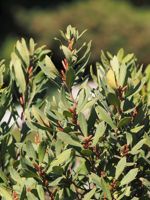
Sweet Gale is a native, nitrogen-fixing shrub known for its aromatic foliage. Tiny glands on the leaves release a balmy, bay leaf-like scent with floral and citrus notes. In spring, the yellowish male catkins provide one of the earliest sources of pollen for bees and other insects. While later in the season, the female catkins produce seeds that are eaten by waterfowl. Sweet Gale is dioecious, meaning male and female flowers occur on separate plants.
Sweet Gale thrives in wet, acidic soils and is commonly found along wetlands and lakeshores. It can help stabilize shorelines, while its dense growth provides valuable cover for wildlife. It is well-suited for naturalization, wetland restoration, and erosion control projects.