 Owned
Owned

Cloudberry vs Blue Honeysuckle
Rubus chamaemorus
Lonicera caerulea
COMING SOON
(new stock expected: fall of 2026)
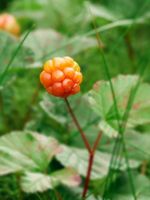
Cloudberry produces berries which taste tart and tangy with a sweet, floral hint. The berries have a creamy texture when overripe. They are often used to make jams, juices, and liquors. The berries are a pale red colour and when ripe turn more orange/amber. They do not grow very tall, generally reaching only 10-25 cm.
Cloudberry has distinct male and female plants. In order to produce berries, both must be present and pollinate with each other. Berries are produced at maturity, typically 5-7 years, and produce 1 berry per stem. The plant spreads naturally as they grow using modified underground stems (rhizomes), forming more plants over time in the same area.
This plant can be found wild in Canada’s boreal forest. In Newfoundland and Labrador, this plant is known as the Bakeapple and is a significant regional food. Similarly the Côte-Nord region of Quebec also has a long history of using this berry.
Note: Cloudberries require very specific soil conditions. They need well-drained soil with a pH between 3.5 and 5.0. Also sensitive to salt and dry conditions.
Note: Our seedlings are grown from seed and are too young to identify their sex.
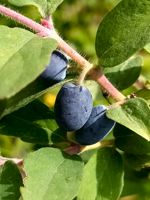
Blue Honeysuckle (wild Haskap or Honeyberry) is a cold hardy shrub and native to most of Canada. The pale yellow to white flowers provide nectar and pollen for bumblebees and other pollinators. The edible berries resemble elongated blueberries. They have a sweet-tart flavour often described as a blend of blueberry, raspberry, and blackcurrant, though wild berries can vary in taste.
Compared to popular cultivated varieties, the berries of Blue Honeysuckle are typically smaller and more variable in shape and flavour. While some enjoy eating the berries fresh, they are more commonly used in baking and preserves. Blue Honeysuckle can be used in hedgerows, border plantings, and naturalized landscapes. It may also serve as a cross-pollination partner in haskap plantings or as a decoy planting to draw birds and wildlife away from more desirable fruit crops.
Blue Honeysuckle has limited self-pollination and produces better yields when planted with other haskap plants or varieties for cross-pollination. Wild populations have not been studied as extensively as cultivated varieties, and because these plants are grown from seed, bloom timing and cross-pollination compatibility may vary.