 Owned
Owned

Mon-Fri 9am - 5pm Mountain time
Cart reopens in October
Subscribe to our email list
to stay updated
Northern Bayberry vs Japanese Quince
Myrica pensylvanica
Chaenomeles japonica
NOT AVAILABLE THIS SEASON - MIGHT RETURN
NOT AVAILABLE THIS SEASON - MIGHT RETURN
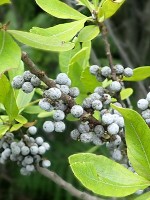
Northern Bayberry makes an excellent hedge or feature shrub. It will retain its leaves in warmer climates but drops them in colder areas. They produce blue-grey berries that have a wax coating on them that can be used to make candles or soaps.
In colder hardiness zones the leaves turn an attractive orange to red colour in the fall, making it a striking addition to your landscape.
Northern Bayberry is native to Nova Scotia and tolerates both drought and wet conditions. It is also a nitrogen fixer that tolerates poor soil conditions.
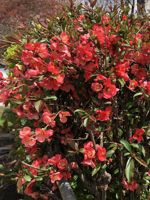
Japanese Quince has bright, orange to red showy flowers that bloom in early spring. The flowers appear before the leaves and may continue to bloom after leaves emerge. Flowers grow on old wood, so pruning after flowering will help to promote new growth next spring. They produce yellow-green fruit that taste bitter when eaten raw, typically they are better suited for making preserves.
It can be used as a stand alone ornamental shrub, as a low hedge, or can be trained to grow against a wall. In late winter, branches of Japanese Quince can be cut and brought indoors where they will bloom on their own. They are deer and rabbit tolerant. The branches are spiny making them well suited for keeping unwanted wildlife away.
Northern Bayberry Quick Facts
Japanese Quince Quick Facts
Toxicity: Warning: The wax from bayberry fruit is considered toxic and may be carcinogenic.