 Owned
Owned

Pawpaw vs American Plum
Asimina triloba
Prunus americana
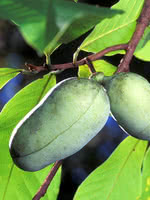
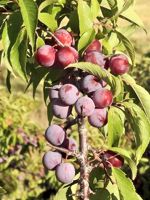
The Pawpaw tree produces delicious, sweet fruit with a unique banana-mango flavor. These oblong fruits start yellowish-green and mature to a dark brown in the fall. It is best to leave them on the tree until ripe, as they do not ripen well once picked. Pawpaws can be enjoyed fresh, in baking, or in ice cream.
Pawpaws produce the largest native fruit in North America. They typically grow as a small understory tree or large shrub on wooded slopes, in ravines, and along stream banks. They often spread through root suckers, forming dense thickets over time.
For fruit production to occur more than one genetically different Pawpaw tree is required. Our Pawpaw seedlings are grown from seed so they are all genetically different.
Note: Avoid eating the seeds and skin of the Pawpaw fruit as they can cause stomach pain for some individuals. Contact with the skin of the fruit can also result in skin irritation, so it is recommended to wear gloves during harvest. Plant this tree once. Due to its large tap root transplanting is not recommended.
American Plum is a cold-hardy wild plum native to North America that grows as a small tree or large multi-stemmed shrub. Small, firm, red plums ripen from mid to late summer; the skin is tough and tart, whereas the flesh is sweet and juicy. While some enjoy eating them fresh, they are more commonly used for baking and preserves. It is considered a universal pollinizer for other plum varieties and is often used for grafting or as a rootstock.
In spring, American Plum produces abundant white to pink flowers that attract a variety of pollinators, providing an important early-season source of nectar and pollen. It also serves as a host plant for numerous moth and butterfly species. In its native range, it is recognized as an important keystone plant, as it has a disproportionately large impact on local ecosystems.
American Plum tolerates a wide range of soil conditions, from acidic to alkaline, and heavy clay. It is well suited to a variety of projects, including fruit orchards for cross-pollination, as well as pollinator plantings, naturalization, and restoration projects.
Pawpaw Quick Facts
American Plum Quick Facts
Toxicity: leaves, stems, pits contain cyanide