 Owned
Owned

Black Elderberry vs Boreal Bliss Haskap
Sambucus canadensis
Lonicera caerulea Boreal Bliss
NOT AVAILABLE THIS SEASON - MIGHT RETURN
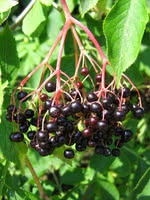
Black Elderberry is a deciduous shrub native to eastern North America. You can plant this shrub in moist areas and it will help stabilize your soil. You can also use it on rural properties anywhere you'd use a lilac.
Black Elderberries are considered to be partially self-pollinating. So while they will still produce some berries without cross-pollination, planting with another variety will increase yields. Consider planting with Ranch Elderberry or Bob Gordon Elderberry.
Warning: the seeds, stems, leaves, roots, and uncooked berries of the Black Elderberry are poisonous to humans when eaten in quantity. You should cook the berries to make them safe for human consumption.
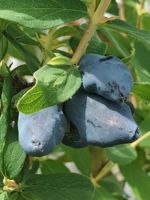
Boreal Bliss Haskap is a variety recently released by the University of Saskatchewan. Haskaps generally taste like a cross between a blueberry and a raspberry. The flavour of Boreal Bliss is described as excellent, with a nice aroma and unique aftertaste. For peak flavour, wait about a week after the berries turn blue before harvesting. The berries are well suited to fresh eating, freezing, baking, and preserves.
Boreal Bliss is the first Haskap cultivar to be released with wild Canadian lineage. Its productivity is very good, with bloom and ripening times closely matching Boreal Beast.
For optimal fruit production, cross-pollination is required. Haskaps need to be planted with a compatible variety. Compatibility is influenced by both bloom time and genetics.
Boreal Bliss Haskap is a late-pollinating variety and pairs well with Boreal Beast and Boreal Blizzard
Black Elderberry Quick Facts
Boreal Bliss Haskap Quick Facts
Toxicity: leaves, stems, and uncooked berries are poisonous to humans