 Owned
Owned

Northern Catalpa (Cigar Tree) vs American Plum
Catalpa speciosa
Prunus americana
NOT AVAILABLE THIS SEASON - MIGHT RETURN
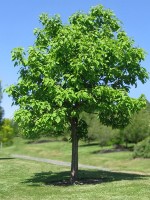
Northern Catalpa is a striking feature tree with showy flowers, and very large leaves. Its orchid-like flowers are white with yellow and purple accents, and they have a pleasant fragrance. They bloom from late spring to early summer and can last up to two weeks, attracting hummingbirds and pollinators. The leaves are very large, ranging from 15-30 cm long, 12-20 cm wide, forming a canopy that makes it a good shade tree.
They can tolerate dry conditions as well as standing water, air pollution, and salt. These factors and its beauty contribute to its growing popularity as both a boulevard and ornamental tree in colder areas.
Northern Catalpa produces long bean-like capsules and are sometimes called the Cigar Tree in reference to this fruit.
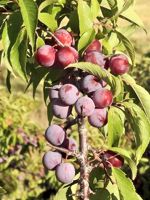
American Plum is a cold-hardy wild plum native to North America that grows as a small tree or large multi-stemmed shrub. Small, firm, red plums ripen from mid to late summer; the skin is tough and tart, whereas the flesh is sweet and juicy. While some enjoy eating them fresh, they are more commonly used for baking and preserves. It is considered a universal pollinizer for other plum varieties and is often used for grafting or as a rootstock.
In spring, American Plum produces abundant white to pink flowers that attract a variety of pollinators, providing an important early-season source of nectar and pollen. It also serves as a host plant for numerous moth and butterfly species. In its native range, it is recognized as an important keystone plant, as it has a disproportionately large impact on local ecosystems.
American Plum tolerates a wide range of soil conditions, from acidic to alkaline, and heavy clay. It is well suited to a variety of projects, including fruit orchards for cross-pollination, as well as pollinator plantings, naturalization, and restoration projects.
Northern Catalpa (Cigar Tree) Quick Facts
American Plum Quick Facts
Toxicity: leaves, stems, pits contain cyanide