 Owned

Canada Plum vs Sour Cherry
Prunus nigra
Prunus cerasus
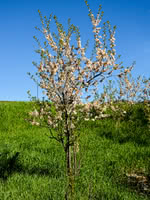
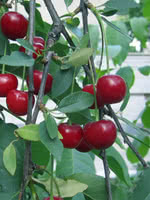
Canada Plum is a cold-hardy wild plum native to North America with small red fruit. They ripen in mid to late summer, with bitter, astringent skin surrounding sweet, slightly acidic flesh that clings to the stone. While some enjoy eating the plums fresh, they are more commonly used for baking and preserves. It is considered a universal pollinizer for other plum varieties and is often used for grafting or as a rootstock.
White to pink flowers appear in spring, often before the leaves, providing an early source of nectar and pollen for native bees and other pollinators. Birds and other wildlife also feed on the fruit, adding to its ecological value. Canada Plum can grow as a small tree or large, multi-stemmed shrub. It is well suited to a variety of projects, including fruit orchards for cross-pollination, as well as pollinator plantings, naturalization, and restoration projects.
Sour Cherry is cold-hardy and typically grows as a small tree. In late spring, it produces clusters of fragrant white blossoms that mature into bright red, tart fruit. Although the cherries can be eaten fresh, they are most commonly used in baking and preserves.
While not native to North America, Sour Cherry serves as a larval host plant for the Eastern Tiger Swallowtail (Papilio glaucus), a butterfly native to eastern North America.
Sour cherries are self-fertile; however, planting near additional cherry trees for cross-pollination can increase yields.
This Sour Cherry is produced from seed collected from an Evans Cherry and is not clonally reproduced.