 Owned

Washington Hawthorn vs American Plum
Crataegus phaenopyrum
Prunus americana
CUSTOM GROW
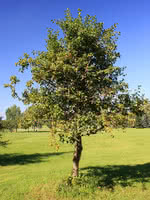
Washington Hawthorn is an attractive ornamental shrub that is dense enough to plant as a privacy screen. It produces clusters of white blooms in late spring to early summer.
Washington Hawthorn's red berries last throughout winter, bringing squirrels and birds to your property. In the fall, its foliage turns beautiful orange, scarlet, or purple.
One of the most overlooked trees on the prairies. This tree is often used as rootstock, a wildlife attractor, or a boulevard hedge. Give this one a second look.
This species is also known as one of the more salt-tolerant species for those with saline soils.
Please note: this plant is poisonous to dogs.
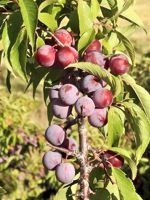
American Plum is a cold-hardy wild plum native to North America that grows as a small tree or large multi-stemmed shrub. Small, firm, red plums ripen from mid to late summer; the skin is tough and tart, whereas the flesh is sweet and juicy. While some enjoy eating them fresh, they are more commonly used for baking and preserves. It is considered a universal pollinizer for other plum varieties and is often used for grafting or as a rootstock.
In spring, American Plum produces abundant white to pink flowers that attract a variety of pollinators, providing an important early-season source of nectar and pollen. It also serves as a host plant for numerous moth and butterfly species. In its native range, it is recognized as an important keystone plant, as it has a disproportionately large impact on local ecosystems.
American Plum tolerates a wide range of soil conditions, from acidic to alkaline, and heavy clay. It is well suited to a variety of projects, including fruit orchards for cross-pollination, as well as pollinator plantings, naturalization, and restoration projects.
Washington Hawthorn Quick Facts
American Plum Quick Facts
Toxicity: leaves, stems, pits contain cyanide
In row spacing: 0.9 m (3 ft)