 Owned

Silver Buffalo Berry vs Red Mammoth Raspberry
Shepherdia argentea
Rubus idaeus Red Mammoth
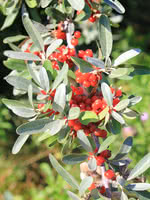
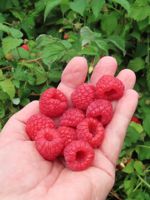
Silver Buffalo Berry is a cold hardy, ornamental shrub that is commonly used in the first row of shelterbelts instead of caragana or lilac. It features subtle yellow flowers, smooth grey bark, and red fruit. On occasion orange fruit is produced and rarely a yellow fruit. Please note: we regularly collect the rare yellow and orange fruit to use for our seed source.
Long-lived and slow growing, Silver Buffalo Berry is commonly found around sloughs, in coulees, and on light soils across the prairies, and grows best in full sun.
Buyers can enjoy increased bird life to their property, as this shrub acts as a habitat plant. It is also commonly planted for its ornamental and winter interest. It is native to parts of central and western North America.
This species is also known as one of the more salt-tolerant species for those with saline soils.
Note: this berry has mixed reviews when fresh, but makes a desirable jam or jelly with what is described as a clove and pear taste.
Red Mammoth is a high-yielding variety released in 1999 by the University of Saskatchewan Fruit Program, SK. It produces distinctively large bright red berries about 1 inch wide. It is also more cold hardy than older raspberry cultivars. Red Mammoth is firm which makes it suitable for commercial production and sweeter than Boyne. Needs to be trellised as canes are not as sturdy as other varieties.
Red Mammoth Raspberry is a floricane-fruiting variety, meaning it primarily produces fruit on second-year canes (previous season’s new growth). They are also referred to as summer-bearing. In late winter or early spring, cut back all spent floricanes, leaving only last season's canes.
Raspberries are self-fertile, meaning they do not require cross-pollination from another variety to produce fruit.
Silver Buffalo Berry Quick Facts
Red Mammoth Raspberry Quick Facts
In row spacing: 0.9 - 1.2 m (3 - 4 ft)