 Owned
Owned

Mon-Fri 9am - 5pm Mountain time
Cart reopens in October
Subscribe to our email list
to stay updated
Sea Buckthorn (Seaberry) vs Honey Queen Raspberry
Hippophae rhamnoides l.
Rubus x Honey Queen
COMING SOON
(new stock expected: fall of 2026)
NOT AVAILABLE THIS SEASON - MIGHT RETURN
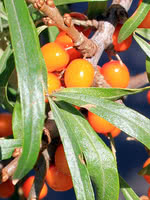
Sea Buckthorn, aka Seaberry, is a nitrogen fixing shrub that produces attractive berries high in vitamin C.
While we can't confirm claims that the berries are effective in treating various ailments, many people believe consuming the berries helps with arthritis, infections, and asthma, among other things.
Sea Buckthorn plants have attractive pale silvery-green leaves, dense branches, and large thorns, people like to grow in ornamental hedges or as a first row in a shelterbelt.
Note: Sea Buckthorn is dioecious, meaning male and female flowers grow on separate plants. Both are required for fruit production, though only female plants bear fruit. A plant’s sex typically cannot be identified until its third or fourth year. Our seedlings are too young to determine their sex.
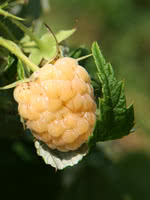
Honey Queen Raspberry is known for its sweet honey flavor and unique yellow color. Its berries are soft and medium-sized, nice for picking and eating in the summer.
Honey Queen was developed in Rocky Mountain House by Robert Erskine and is very winter hardy. Canes are yellowish, floricane, arched and moderately spiny.
Honey Queen raspberries benefit from trellising for best results. While all raspberries prefer full sun, this variety is more shade-tolerant and can still produce well in partial shade.
The Honey Queen Raspberry is a fast-growing floricane. This means that raspberries will not grow on canes the year they first grow. The mature canes they do grow on, however, produce more berries than primocane varieties.
Check out some video of a Honey Queen Raspberry we saw this summer on our YouTube Channel. Click here.
Sea Buckthorn (Seaberry) Quick Facts
Honey Queen Raspberry Quick Facts
In row spacing: 0.9 - 1.2 m (3 - 4 ft)