 Owned
Owned

Mon-Fri 9am - 5pm Mountain time
Cart reopens in October
Subscribe to our email list
to stay updated
Common Snowberry vs Narrow-Leaved Coneflower (Echinacea)
Symphoricarpos albus
Echinacea angustifolia
NOT AVAILABLE THIS SEASON - MIGHT RETURN
(new stock expected: fall of 2027)
NOT AVAILABLE THIS SEASON - MIGHT RETURN
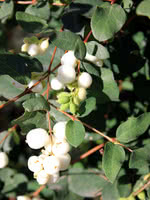

Common Snowberry is a small deciduous shrub with characteristic white to pink flowers and clusters of white fruit.
This North American native species is very adaptable, and can be used for erosion control in riparian and restoration areas. Snowberry's fruit attracts wildlife, and livestock can consume the berries without issue.
Narrow-Leaved Coneflower is a native perennial wildflower known for its pink to pale purple, daisy-like blooms. The petals (rays) droop downwards, around a dark, domed center, giving the flower a cone-like appearance. The nectar-rich blossoms attract a wide variety of pollinators, including native bees and butterflies. After flowering, the seeds provide food for birds, further adding to its ecological value.
Once established, it is drought-tolerant due to its deep taproot, which also helps stabilize soil. Narrow-Leaved Coneflower thrives in a variety of well-drained soils, including sandy, rocky, and alkaline. It often grows alongside the native grasses that characterize prairie and grassland ecosystems, making it well-suited for prairie and grassland restoration, naturalization, and pollinator gardens.
Common Snowberry Quick Facts
Narrow-Leaved Coneflower (Echinacea) Quick Facts
Toxicity: berries toxic to humans