 Owned
Owned

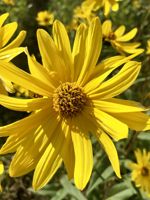
Black-Eyed Susan vs Nuttalls Sunflower
Rudbeckia hirta
Helianthus nuttallii
NOT AVAILABLE THIS SEASON - MIGHT RETURN
NOT AVAILABLE THIS SEASON - MIGHT RETURN
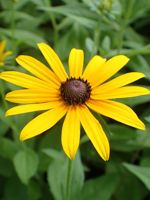
Black-Eyed Susan is a striking native wildflower known for its bright yellow, daisy-like flowers with dark center disks. With deadheading, the plant can bloom for an extended period, from mid-summer to early fall. These cheerful flowers attract a variety of pollinators, including bees and butterflies. Adding to its ecological value, the plant also acts as a host for the Wavy-Lined Emerald Moth (Synchlora aerata) and the Silvery Checkerspot (Chlosyne nycteis) butterfly.
While it is typically a short-lived perennial or biennial, the plant freely self-seeds. This allows it to persist in the landscape, particularly in natural areas where it can spread and establish itself. This plant is drought-tolerant, salt-tolerant, and deer and rabbit-resistant, making it ideal for challenging environments. The Black-Eyed Susan is well suited to wildflower gardens, pollinator gardens, as well as slopes, banks, and naturalized areas.
Nuttall’s Sunflower is a native perennial wildflower known for its bright, golden-yellow blooms. Flowering from mid to late summer, it offers a late-season nectar source for various bees, butterflies, and other pollinators, while the seeds provide a fall food source for birds. The upright growth habit adds structural height and visual variety to your landscape.
Nuttall’s Sunflower can be found growing in moist to wet meadows, prairies, and open spaces. It can spread quickly via underground rhizomes, making it ideal for large-scale plantings. It is well-suited for naturalization, soil stabilization, riparian zones, and wetland restoration projects. If planting in smaller urban yards or gardens, extra care and maintenance will be required to limit its spread.