 Owned
Owned

Mon-Fri 9am - 5pm Mountain time
Cart reopens in October
Subscribe to our email list
to stay updated
Twining Honeysuckle vs Spicebush
Lonicera dioica
Lindera benzoin
CUSTOM GROW
NOT AVAILABLE THIS SEASON - MIGHT RETURN
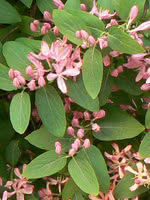
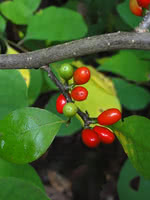
Twining Honeysuckle is a vine native to the forests of Canada and the United States.
It can often be found winding up the bark of large trees or spreading out as a ground cover where no supports are present. You will love the attractive, yellow-orange flowers with pink centers which turn into red, inedible berries.
Consider Twining Honeysuckle when trying to achieve a natural, spreading, unkempt look for your garden.
The Spicebush is an unique ornamental shrub that blooms with vibrant yellow flowers and bright green foliage. The foliage goes from green to yellow in the autumn, adding fall interest to your garden.The plant is dioecious, meaning that you will need male and female plants in order to harvest it’s red berries. Berries are only produced on female plants. The berries themselves aren’t that sweet, and are mostly enjoyed by birds and other wildlife.
The Spicebush, also commonly known as Common Spicebush, Northern Spicebush, Wild Allspice, and Benjamin Bush, is named after its distinctive spicy-sweet fragrance that comes from the flowers.