 Owned
Owned

Japanese Quince vs Lewis Mock Orange
Chaenomeles japonica
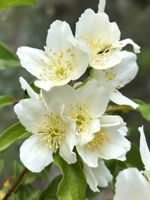
Philadelphus lewisii
NOT AVAILABLE THIS SEASON - MIGHT RETURN
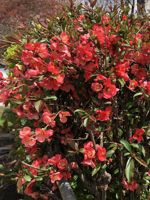
Japanese Quince has bright, orange to red showy flowers that bloom in early spring. The flowers appear before the leaves and may continue to bloom after leaves emerge. Flowers grow on old wood, so pruning after flowering will help to promote new growth next spring. They produce yellow-green fruit that taste bitter when eaten raw, typically they are better suited for making preserves.
It can be used as a stand alone ornamental shrub, as a low hedge, or can be trained to grow against a wall. In late winter, branches of Japanese Quince can be cut and brought indoors where they will bloom on their own. They are deer and rabbit tolerant. The branches are spiny making them well suited for keeping unwanted wildlife away.
Lewis Mock Orange is a flowering ornamental shrub that produces an abundance of white, fragrant blooms. The flowers have a sweet scent similar to orange blossoms, with a hint of pineapple. They bloom for several weeks from late spring to early summer, attracting pollinators and other beneficial insects.
Native to North America, Lewis Mock Orange is found from the southernmost portions of Alberta and British Columbia, and south into the northwestern United States. It makes an attractive shrub and can be used in hedgerows, pollinator gardens, and naturalization projects. Blooms occur on the previous year’s wood, so it is recommended to prune after it has finished flowering.