 Owned
Owned

Sour Cherry vs Capilano Apricot
Prunus cerasus
Prunus Capilano
NOT AVAILABLE THIS SEASON - MIGHT RETURN
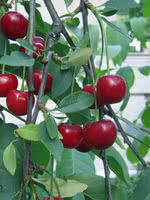
Sour Cherry is cold-hardy and typically grows as a small tree. In late spring, it produces clusters of fragrant white blossoms that mature into bright red, tart fruit. Although the cherries can be eaten fresh, they are most commonly used in baking and preserves.
While not native to North America, Sour Cherry serves as a larval host plant for the Eastern Tiger Swallowtail (Papilio glaucus), a butterfly native to eastern North America.
Sour cherries are self-fertile; however, planting near additional cherry trees for cross-pollination can increase yields.
This Sour Cherry is produced from seed collected from an Evans Cherry and is not clonally reproduced.
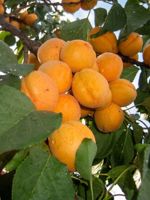
Capilano Apricot is a cold-hardy variety known for its sweet, juicy, full-flavored fruit. It produces white to pink blooms in early spring, before the leaves emerge, followed by golden-yellow, freestone apricots. They ripen from mid-July to early August and are well-suited for fresh eating, baking, wine, canning, and preserves.
The Capilano Apricot originated from three trees planted in Edmonton’s Capilano neighbourhood during the 1960s. As they began producing fruit, local fruit enthusiasts took notice and propagated the trees, with the southernmost becoming particularly popular. Though the original trees no longer exist, the Capilano Apricot remains a widely sought-after cold-hardy variety.
Capilano Apricot is generally considered self-pollinating, but planting with another variety for cross-pollination can increase yields.
Note: The early bloom time makes the flowers vulnerable to spring frosts, which can reduce or eliminate the fruit crop