 Owned
Owned

Mon-Fri 9am - 5pm Mountain time
Cart reopens in October
Subscribe to our email list
to stay updated
Sour Cherry vs Japanese Quince
Prunus cerasus
Chaenomeles japonica
COMING SOON
(new stock expected: fall of 2026)
NOT AVAILABLE THIS SEASON - MIGHT RETURN
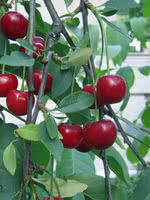

Sour Cherry is cold-hardy and typically grows as a small tree. In late spring, it produces clusters of fragrant white blossoms that mature into bright red, tart fruit. Although the cherries can be eaten fresh, they are most commonly used in baking and preserves.
While not native to North America, Sour Cherry serves as a larval host plant for the Eastern Tiger Swallowtail (Papilio glaucus), a butterfly native to eastern North America.
Sour cherries are self-fertile; however, planting near additional cherry trees for cross-pollination can increase yields.
This Sour Cherry is produced from seed collected from an Evans Cherry and is not clonally reproduced.
Japanese Quince has bright, orange to red showy flowers that bloom in early spring. The flowers appear before the leaves and may continue to bloom after leaves emerge. Flowers grow on old wood, so pruning after flowering will help to promote new growth next spring. They produce yellow-green fruit that taste bitter when eaten raw, typically they are better suited for making preserves.
It can be used as a stand alone ornamental shrub, as a low hedge, or can be trained to grow against a wall. In late winter, branches of Japanese Quince can be cut and brought indoors where they will bloom on their own. They are deer and rabbit tolerant. The branches are spiny making them well suited for keeping unwanted wildlife away.