 Owned

Borealis Haskap (Honeyberry) vs Red Mammoth Raspberry
Lonicera caerulea Borealis
Rubus idaeus Red Mammoth
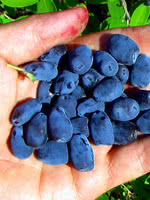
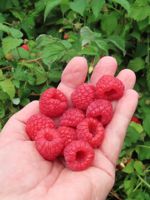
Borealis Haskap is a popular variety due to its great-tasting, sweet-tart berries. The flavour of Haskaps is generally described as a cross between a blueberry and a raspberry. Borealis Haskaps are well suited to fresh eating, baking, and preserves.
It has strong fruit holds and is not very firm so it does not do well when handled by equipment. This variety is a favourite for home gardens and U-Picks.
For optimal fruit production, cross-pollination is required. Haskaps need to be planted with a compatible variety. Compatibility is influenced by both bloom time and genetics.
Borealis Haskap is an early-pollinating variety and pairs well with Aurora and Honey Bee.
Red Mammoth is a high-yielding variety released in 1999 by the University of Saskatchewan Fruit Program, SK. It produces distinctively large bright red berries about 1 inch wide. It is also more cold hardy than older raspberry cultivars. Red Mammoth is firm which makes it suitable for commercial production and sweeter than Boyne. Needs to be trellised as canes are not as sturdy as other varieties.
Red Mammoth Raspberry is a floricane-fruiting variety, meaning it primarily produces fruit on second-year canes (previous season’s new growth). They are also referred to as summer-bearing. In late winter or early spring, cut back all spent floricanes, leaving only last season's canes.
Raspberries are self-fertile, meaning they do not require cross-pollination from another variety to produce fruit.