 Owned
Owned

Carmine Jewel Cherry vs Sour Cherry
Prunus x kerrasis Carmine Jewel
Prunus cerasus
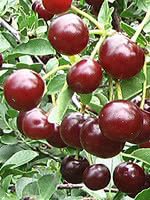
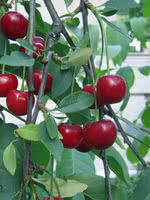
Carmine Jewel Cherry is a cold-hardy dwarf sour cherry. It is typically highly productive and one of the first varieties to ripen in summer. It produces deep red, tart fruit that are well-suited for fresh eating, baking, and preserves. In the spring, beautiful white flowers cover the branches, adding ornamental value.
Carmine Jewel Cherry was developed at the University of Saskatchewan. It is recommended to grow dwarf sour cherries as a shrub rather than a small tree. The shrub form tends to bear fruit earlier and is less susceptible to winterkill.
Sour cherries are self-fertile; however, planting with additional varieties for cross-pollination can increase yields.
Sour Cherry is cold-hardy and typically grows as a small tree. In late spring, it produces clusters of fragrant white blossoms that mature into bright red, tart fruit. Although the cherries can be eaten fresh, they are most commonly used in baking and preserves.
While not native to North America, Sour Cherry serves as a larval host plant for the Eastern Tiger Swallowtail (Papilio glaucus), a butterfly native to eastern North America.
Sour cherries are self-fertile; however, planting near additional cherry trees for cross-pollination can increase yields.
This Sour Cherry is produced from seed collected from an Evans Cherry and is not clonally reproduced.